 United Kingdom, GBP
 United States, USD
 Canada, CAD
 Australia, AUD
 New Zealand, NZD
 European Union, EUR
 France, EUR
 Switzerland, CHF
 Germany, EUR
From ‘bad texter’ to ‘bad politics’, there’s been a shift in what’s considered a dating ‘red flag’. A Lovehoney survey reveals that politics has entered the chat, and for many of us, it’s a dating dealbreaker.
We surveyed over 2,000 Brits to gain insight into the evolving landscape of dating and relationships, asking ‘Would you ever date someone with a different political view to you?’
On the surface, the numbers signalled political openness amongst a quarter of respondents, as 25% answered yes, they would. Yet 19% respondents said they definitely or probably would not and 13% respondents admitted to sitting on the fence.
But attitudes towards dating across the political divide vary significantly by gender. Our data shows a stark contrast between male and female respondents, with 31% of men certain they would date someone with a different political view, compared to only 19% of women.
Below, you can find out how significant a dealbreaker politics might be, according to gender, age, sexuality, and location. You’ll also find insights from Annabelle Knight, Lovehoney’s sex and relationships expert, alongside a good debunking of some of the biggest myths about dating across an ideological divide.

Which gender is more open to dating with different politics?
The data shows that men are more open than women when it comes to dating people with a different political opinion. 31% of men answered ‘Yes, definitely’, and 44%, ‘Yes, probably’ - meaning that the majority of men (75%) were open to the idea on some level, compared to only 62% of women.
Meanwhile, 7% of men and women answered ‘No, definitely not’, showing that there’s a significant minority across both genders who would never consider dating someone with an opposing political stance.
But why do men care significantly less than women about political stance?
We can’t say for certain, but it could be down to attitudes towards risk. Even today, the gender pay gap prevails in the UK, demonstrating that men typically experience a certain level of socio-economic security and autonomy that many women don’t. It’s not surprising, therefore, that women can be more cautious and risk averse, while men may be more comfortable taking risks.
With that in mind, politics may feel like more of a talking point for many men, rather than a matter of personal risk. Let’s take a closer look at the gender breakdown.
Women are becoming increasingly left-leaning, while men are becoming increasingly right-leaning, studies show. This is especially true amongst younger generations, and it may impact their dating habits.
Women, would you ever date someone with a different political view to you?
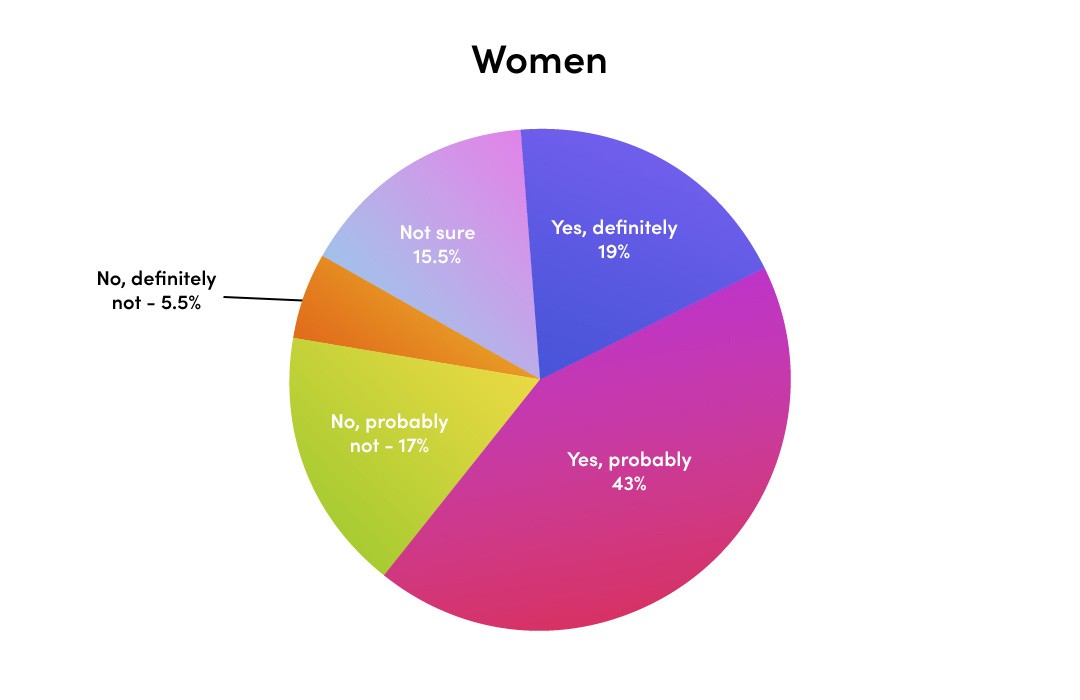
Our survey results certainly seem to reflect this growing political gender gap. Less than one in five women truly feel comfortable dating across the divide, with 19% answering ‘Yes, definitely’, they would date someone with different political views.
43% of women said they probably would date across the divide, and 37% wouldn’t or weren’t sure. So, why are over a third of women uneasy about misaligned political stances?
“The results point to the wider context that women may have less choice to turn a blind eye to political stance; the social and economic impact politics has on women makes it impossible to ignore,” says Annabelle. “For many women, compatibility relies on deep-rooted moral and emotional alignment, based on empathy, respect, and shared values.”
Not only that, but the algorithms on social media apps like TikTok and Instagram can reinforce political viewpoints and create trends in the way people view relationships. (Just look up ‘heterofatalism’ and the ‘4B movement’ if you don’t know these terms already!)
Ultimately, the stakes can feel higher for women when dating across the political divide. Political leanings can imply certain expectations or values when it comes to family dynamics and gender roles within relationships. At best, a woman might feel misunderstood by a partner with very different political views; at worst she might actually feel mistreated or unsafe.
“Whether politics is a dating dealbreaker for women is entirely their choice,” says Annabelle. “Mutual respect, trust, and understanding are paramount.”
Men, would you ever date someone with a different political view to you?
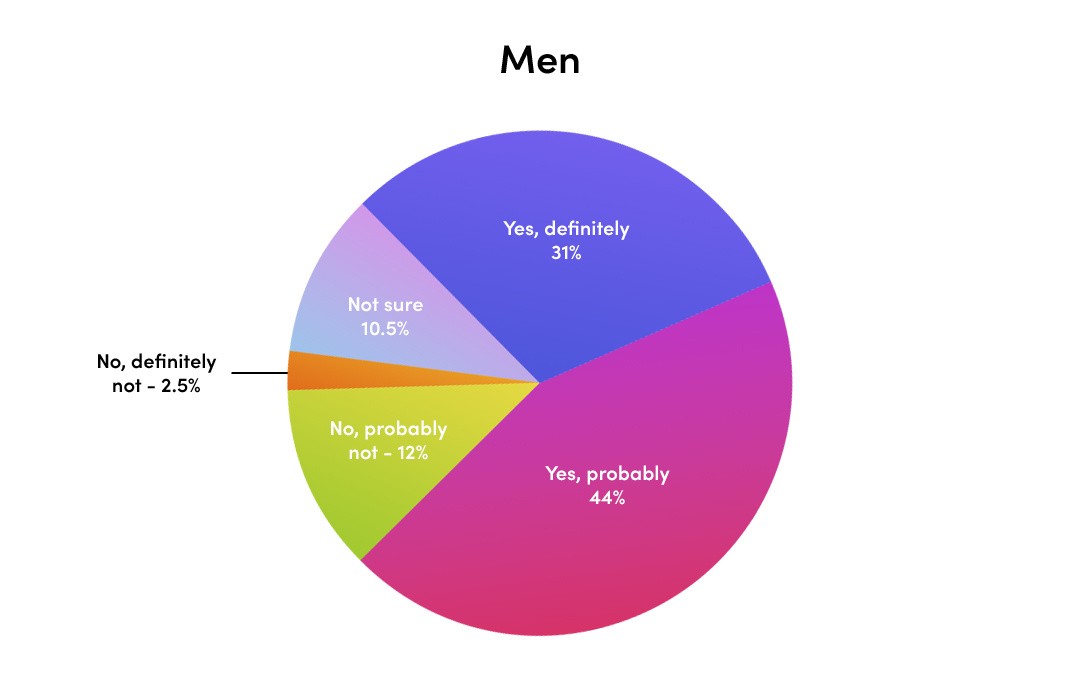
The results reveal men are more open to political differences with almost one in three being totally open to dating across political lines, compared to one in five women.
Only 2% of men said they definitely would not date across the political divide. Despite British men – particularly Gen Z – reportedly becoming increasingly right-leaning amid the rise of the ‘manosphere’, many feel quite comfortable separating ideology from dating compatibility.
“With so few men ruling out dating across political lines, it’s clear that many believe attraction, chemistry, and shared values matter more than ideological alignments,” says Annabelle. “Perhaps they’re able to compartmentalise easier than women, because politics don’t creep into their personal lives as overtly.”
So, what should we do about it?
When navigating conversations about politics, especially if you’re in the early stages of dating someone, it’s can be helpful to lead with curiosity.
Ask open questions like “What experiences do you think shaped your view on this?” and try to find common ground rather than undermining the other person’s beliefs. This will help avoid defensiveness, letting you have a more relaxed and open-minded conversation.
You might be surprised by how much you actually have in common! And if not, it’s OK to extract yourself from the conversation by saying something like “This is quite a loaded topic, isn’t it? Do you mind if we talk about it another time?”
Which generation is more open to dating with different politics?
Gen Z are often thought of as the more progressive generation and the most accepting of diversity when it comes to gender identity, sexuality, disability, or race. And yet, they’re the least open-minded when it comes to dating across the political divide.
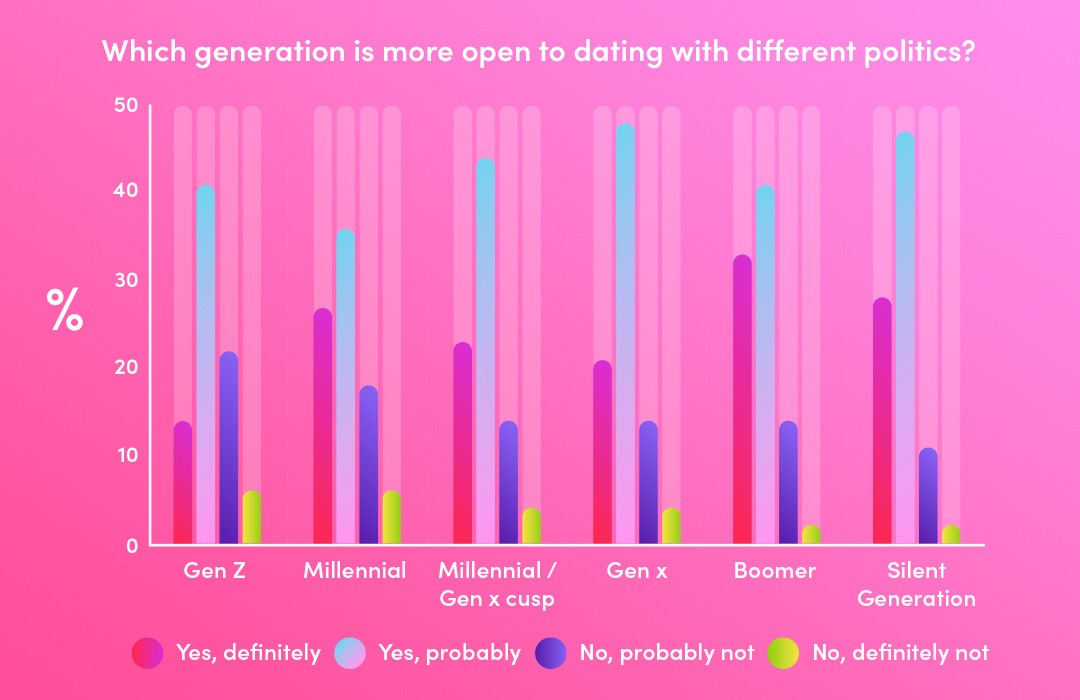
Only 14% of 18–24-year-olds answered that they’d ‘definitely’ consider dating someone with a different political stance. That’s significantly less than the 28% of over 65s that said the same.
Overall, older generations are more accepting when it comes to personal politics, with 33% of people aged 55-64 (Boomers), saying they couldn’t care less. So, what’s driving this divide? Well, it’s a nuanced one, but we have a theory or two.
It’s possible that the older generations have merely switched up their priorities with experience and age.They could be more inclined to separate politics from personal connection, prioritising other signals of compatibility like humour and shared life experiences over ideological alignment.
After all, they’ve experienced the most changes in the political and social landscape over decades of shifting governments. The so-called ‘Silent Generation’ may discuss politics less or simply view political differences as just one piece of a puzzle – rather than a reflection of someone’s character or morality.
Meanwhile, Gen Z daters are growing up in an era where politics and identity are intertwined, and many people see political views as moral statements about how you treat others. In that world, political differences are personal, and in-turn become dating dealbreakers.
“Younger generations are more likely to consider politics to be personality, meaning that your politics reflect who you are as a person, whereas older generations are more likely to follow a ‘we can agree to disagree’ narrative,” says Annabelle.
Gen Z
Gen Z women were the least open of all groups, with only 13% ‘Yes, definitely’, and 26% answering ‘No, definitely not’. Gen Z daters seem to view political beliefs as a reflection of moral combability, not a mere ‘difference of opinion’. Overall, only 14% of 18–24-year-olds said they would definitely date someone with different politics.
Millennials
Millennial men are the most open of all groups, with 35% answering ‘Yes, definitely’, compared with 21% of millennial women. This age group has grown up balancing online debate with real-life relationships – and it shows.
Young millennials are quite flexible compared to Gen Z, with 27% of 25–34-year-olds saying ‘Yes definitely’. That flexibility dips for older millennials on the Gen X cusp, though. 23% of 35–44-year-olds would definitely consider dating someone with a different political opinion.
Gen X
Among 45–54-year-olds, openness dips further to 21%. This group tends to have more settled beliefs and long-term relationship experience like the generations before them, which may explain why they appear to be less likely to overlook ideological divides. For this age group, political stance may reflect their broader lifestyle, values, and world view.
Boomers
Boomers have a perspective of cultural and political change over decades, and 33% of those aged 55-64 answered ‘Yes, definitely’ to dating someone with a different political stance. They’ve seen opinions evolve as governments change and may value shared connection first and foremost.
Silent Generation
Like Boomers, results from the Silent Generation point to a willingness to agree to disagree, with 28% answering ‘Yes, definitely’. Perhaps being a more culturally conservative generation means this age group is less likely to discuss politics at all.
Which region is more open to dating with different politics?
The East of England appears the most comfortable with political differences, with 33% answering ‘Yes, definitely’ to dating someone with different views. Wales (32%) and Yorkshire and the Humber (28%) followed close behind.
Meanwhile, the red flags are being waved frantically in the East Midlands and London, with only 20% in the East Midlands saying ‘Yes’ they would ‘definitely’ date someone of a different political view, closely followed by London at 22%.
The highest definite ‘No’ is also taken by London at 7%. It’s unsurprising that the capital has the most polarising opinions on the importance of political stance. Capital cities bring people together from a multitude of cultural and social backgrounds, and in such an environment, political opinions can become strong markers of compatibility.
Does sexual orientation factor in dating across politics?
Of the 2,000 people surveyed, we wanted to know whether sexual orientation shapes attitudes towards whether political stance is a dating dealbreaker – turns out, it does.
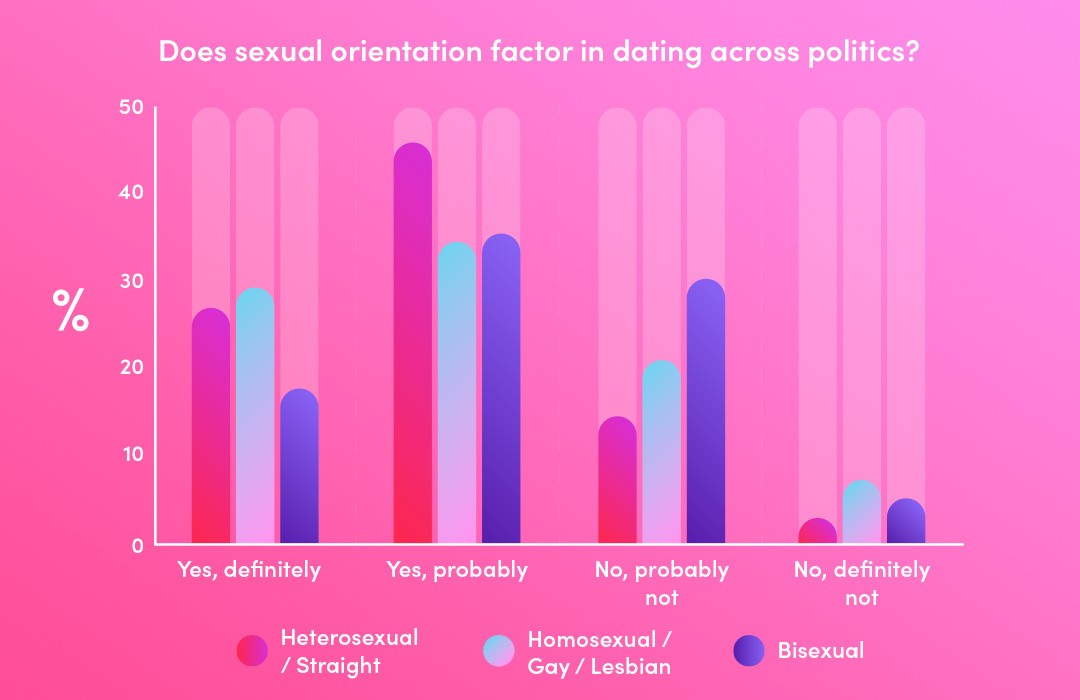
Public policy and political rhetoric can have a direct impact on the rights, freedom, and safety of LGBTQ+ people. That could explain why 7% of homosexual, gay, and lesbian respondents draw a firm line against dating across the political divide.
“For those in the LGBTQIA+ community, politics isn’t abstract,” says Annabelle. “It’s tied to real lived experiences, safety, and feeling seen and heard. When someone’s stance could compromise not only their values but their social safety, it’s personal.”
Gay people may care more about their date’s political stance as a form of self-protection – but not everyone in the community feels the same way.
Heterosexual
When asked whether they’d date someone with a different political opinion, heterosexual (or “straight”) people answered:
26% said ‘Yes, definitely’
3% said ‘No, definitely not’
For non-marginalised groups, separating politics from dating is optional, which could be why a relatively small number of straight respondents rule out dating across the political divide.
Homosexual
Gay and lesbian respondents show slightly higher rates of openness than straight respondents, but also the strongest ‘definitely not’ response of any group – suggesting that there are polarised views within this community.
28% said ‘Yes, definitely’
7% said ‘No, definitely not’
It’s possible that intersectional identities (such as race or class) as well as personal experiences impact queer people’s stance on the matter, causing more polarisation within this demographic.
Bisexual
Bisexual respondents are the least likely to say they’d definitely date across political lines, at just 17%. Perhaps bisexual people place more importance on values-based compatibility, formed by navigating both straight and queer dating cultures.
17% said ‘Yes, definitely’
5% said ‘No, definitely not’
“For heterosexual daters, differences in opinion might feel like something to debate or a topic of curiosity, but for queer and bisexual daters, politics can speak to acceptance,” says Annabelle. “For the LGBTQIA+ community, it’s less about disagreement, and more about whether someone truly empathises with your experience and ‘gets’ your reality.”
The truth about politics as a dating ‘red flag’
“Our willingness or reluctance to date across the political divide often reflects how we see relationships generally,” says Annabelle. Some daters remain unbothered by political stance but, for many, it’s a defining factor of compatibility.
In 2026, political alignment is part of our social identity, which means people often believe that the way they vote says something about their values and morals. But how do you know when a difference of opinion is healthy – or a true dealbreaker?
Talking about ‘red flags’ in dating can be a bit of fun but, realistically, the only true red flags are signs of harmful or abusive behaviours in a partner. Everything else is just a matter of preference and personal boundaries.
Let’s look at some of the biggest myths around political red flags in dating.
Myth: “If we disagree politically, it’ll never work.”
Political differences can be an opportunity for partners to openly communicate, listen to each other’s perspective, stay curious, and learn from each other.
That said, context is important. Your lived experience as a queer person or second-generation migrant might make opposing political views a dealbreaker, and that’s entirely personal to you. You can be respectful to others without wanting to date someone whose political views might cause harm to people like you.
If both partners stay open-minded and emotionally mature, they can navigate healthy political conversations despite minor disagreements that don’t cross their boundaries or morals.
Myth: “We must vote the same way to be compatible.”
Healthy relationships are built on trust, mutual respect, and emotional safety – the biggest green flags of all. Every relationship is different, but willingness to grow together is crucial, not just voting the same way.
Political views can adapt over time through age, changes of circumstance, education and lived experiences. That being said, it’s important in relationships that you have shared values and morals. Asking open-ended questions helps gauge whether your values align:
What qualities are most important to you in a partner?
Who are the people you admire most and why?
How do you prefer to show and receive love?
These questions can help keep the conversation natural and non-combative while finding out if you share morals and values.
Myth: “You should never talk about politics on a date.”
Based on the survey results, Gen Z may argue there’s never a bad time to discuss political beliefs, whereas Boomers may choose to shelve politics in favour of more light-hearted discussions around life.
But politics infiltrates our personal lives even in ways we don’t acknowledge, so it’s likely that the topic will arise at some point nonetheless. Rather than dodging the subject, focus on how you go about discussing it.
How someone navigates these conversations reveals their values – if your date dismisses your feelings, tries to gaslight you out of your opinions, and doesn’t make you feel seen or heard, perhaps this seemingly amber flag starts to look red.
*Sources: Lovehoney x Cint survey, 2,022 nationally representative respondents (January 2025)